There is no shortage of ways to move an event from one system to another.
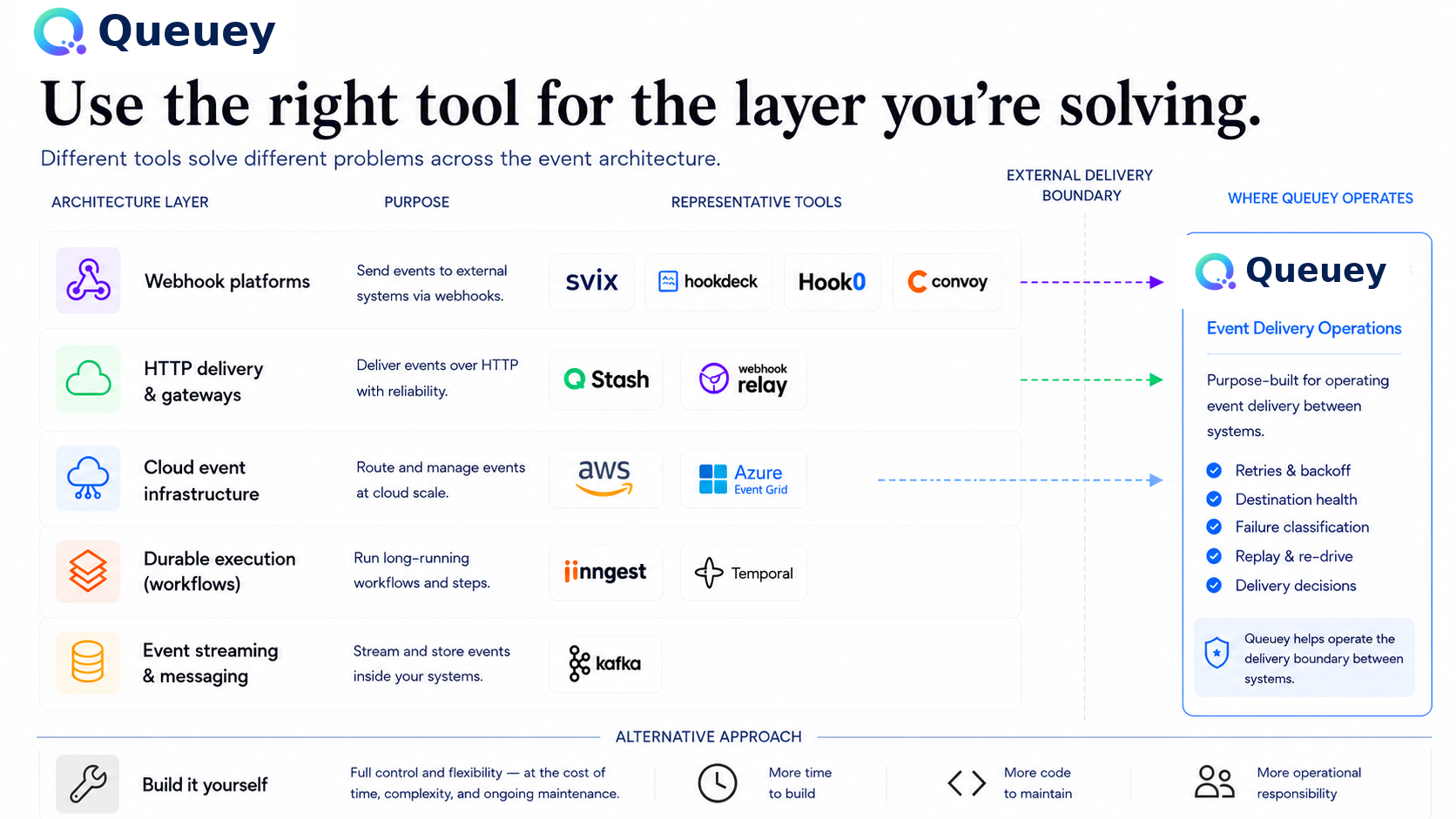
You can use a dedicated webhook platform. Put the message on a serverless queue. Route it through your cloud provider. Run an open-source gateway. Model the delivery as a durable workflow. Publish it to Kafka. Or build the whole thing yourself.
All of those can be correct.
The mistake is comparing them as if they solve the same layer.
Queuey is built around a specific problem inside event-driven systems:
An event reaches the delivery boundary, the destination rejects it or becomes unavailable, and the platform has to decide what should happen next.
That makes Queuey overlap with several categories without being identical to any of them.
This guide compares Queuey with twelve realistic alternatives and, more importantly, explains when Queuey is not the right choice.
Start with the problem, not the logo
Most event-delivery decisions fall into one of six categories:
- Ship webhooks as a product capability — consider Svix, Hook0, Hookdeck or Convoy.
- Move HTTP messages durably and cheaply — consider QStash.
- Route events inside a cloud architecture — consider AWS EventBridge or Azure Event Grid.
- Make application workflows durable — consider Inngest or Temporal.
- Build an internal event backbone — consider Kafka.
- Reach private or on-prem destinations — consider Webhook Relay.
Queuey becomes most relevant when the recurring pain is different:
Operating the unreliable last mile across systems you do not fully control.
That includes external APIs, customer webhooks, ERP systems, partner endpoints and autonomous workflows that need more than "request failed" as their operational context.
The comparison at a glance
| Alternative | What it is best at | Where Queuey is different | Choose the alternative when... |
|---|---|---|---|
| Svix | Productized webhook infrastructure and consumer UX | Failure semantics and delivery operations | You need a mature webhook product surface and embeddable portal |
| Hookdeck | Event gateway, observability and broad delivery tooling | Failure classification + decision records | You need deep gateway tooling, search and broad event operations |
| QStash | Simple, inexpensive serverless HTTP messaging | Deciding whether another attempt is useful | You mainly need durable HTTP requests, scheduling and flow control |
| Hook0 | Open-source outbound webhooks | Shared operational failure model | Self-hosting and straightforward webhook delivery matter most |
| AWS EventBridge | AWS-native event routing | Cloud-agnostic last-mile operations | Your architecture is AWS-native and AWS delivery semantics are enough |
| Azure Event Grid | Azure-native event distribution | Cross-system failure operations | Your event architecture belongs naturally inside Azure |
| Convoy | Self-hostable incoming/outgoing webhook gateway | Failure meaning as a first-class product | You want to own and operate the gateway yourself |
| Webhook Relay | Private/on-prem webhook reachability | What to do after the receiver responds badly | Reaching private/internal endpoints is the hard problem |
| Inngest | Durable jobs, workflows and agents | External delivery as shared infrastructure | You need durable application execution |
| Temporal | Powerful durable workflow orchestration | Specialized delivery operations without workflow rearchitecture | Failure belongs in long-running business workflow logic |
| Kafka | High-throughput event streaming backbone | The external last mile after the consumer | You need topics, consumers, retention and stream processing |
| Build it yourself | Maximum control | Avoiding repeated infrastructure ownership | Delivery is simple, unique strategic IP, or already solved internally |
There is no single "best" platform in that table.
There is a best fit for the layer you actually need to solve.
The category Queuey is trying to own
Traditional reliable delivery is often described like this:
send → fail → wait → retry → retry → DLQ
Modern platforms are already better than that.
Svix has mature retry and endpoint operations. Hookdeck has observability, issues, queueing and circuit breaking. QStash supports explicit non-retryable failures. AWS EventBridge uses HTTP-status-aware retry rules and honors Retry-After. Azure Event Grid has status-specific behavior and can put unhealthy destinations into probation. Convoy tracks endpoint state and supports circuit breaking. Inngest and Temporal let developers mark errors as non-retryable in code. Kafka 4.2 now even makes queue-like consumption more direct through production-ready share groups with per-record acknowledgements and delivery-attempt counts.
So Queuey's differentiation cannot credibly be:
"Other systems retry blindly."
Many do not.
The stronger distinction is this:
Most platforms make retry behavior configurable or programmable. Queuey makes the operational meaning of delivery failure a first-class part of the delivery product.
That is what Queuey calls Failure Intelligence.
Four failures. Four different incidents.
Consider the same event delivered to four receivers:
503 Service Unavailable
The destination is probably temporarily unhealthy.
The useful response may be to protect it, keep events safe and recover later.
429 Too Many Requests
The receiver is explicitly asking the sender to slow down.
The useful response is not merely "failure". It is pacing.
401 Unauthorized
The receiver may be perfectly healthy, but credentials or access are broken.
Repeatedly sending the same request is unlikely to repair authentication.
422 Unprocessable Entity
The receiver can answer, but it cannot process this event.
If the payload itself is invalid, another identical attempt may never succeed.
The engineering primitive in all four cases is an HTTP response.
The operational incident is different every time.
Queuey's thesis is that the delivery layer should carry more of that distinction so every producing application does not have to reinvent it.
Queuey vs dedicated webhook platforms
The closest comparisons are Svix, Hookdeck, Hook0 and Convoy.
These products already solve many parts of production-grade webhook infrastructure: retries, signing, replay, endpoint management, observability and operational tooling.
Choose Svix when the webhook is part of your product UX
Svix is especially strong when a SaaS company needs to expose polished webhooks to customers and give those customers tools to manage their own endpoints.
Its mature webhook infrastructure and embeddable Application Portal are compelling reasons to choose it.
Choose Hookdeck when gateway breadth and observability dominate
Hookdeck has broad event-gateway tooling, deep observability and a separate outbound engine in Outpost. It also has circuit-breaking and recovery capabilities, so this is one of the closest comparisons in the series.
Queuey's differentiation is not "Hookdeck cannot recover." It is the stronger emphasis on classification and decision context around the failure itself.
Choose Hook0 or Convoy when self-hosting matters
Hook0 and Convoy both have open-source/self-hosting stories that can be decisive for teams with infrastructure-control or deployment requirements.
If owning the gateway is a hard requirement, a managed-first Queuey deployment may simply be the wrong architectural choice.
Read: Queuey vs Hook0 → Read: Queuey vs Convoy →
Queuey vs QStash: probably the cleanest technical distinction
QStash is a serverless HTTP messaging system from Upstash. It can store a message, deliver it to an endpoint, retry failed attempts, schedule work and apply flow controls.
It even supports an explicit non-retryable error signal, so again this is not a "smart vs dumb" comparison.
The distinction is closer to:
QStash: how do we give this HTTP message another reliable chance?
Queuey: should this failure get another chance — or does it require a different recovery path?
If you need lightweight, low-cost durable HTTP messaging, QStash is difficult to beat.
If delivery failure itself creates operational work, Queuey's additional layer becomes more relevant.
Queuey vs AWS and Azure: do not replace your cloud because of a webhook
AWS EventBridge and Azure Event Grid are excellent examples of comparisons that need restraint.
Both cloud services already implement thoughtful delivery behavior.
EventBridge has status-aware retries, honors Retry-After and supports SQS dead-letter queues. Event Grid has status-specific retry timing, dead-lettering and probation behavior for unhealthy destinations.
If your architecture lives in one cloud and the built-in delivery behavior solves the problem, use the cloud service.
Queuey's role appears when teams want a cloud-agnostic operational layer around external destinations — especially when the failure lifecycle spans more than retry timing and a DLQ.
A realistic architecture may use both:
AWS/Azure routing → Queuey → external destination
The cloud routes the event.
Queuey operates the last mile.
Read: Queuey vs AWS EventBridge → Read: Queuey vs Azure Event Grid →
Queuey vs Inngest and Temporal: durable execution is a different problem
Inngest and Temporal are much more powerful than Queuey if what you need is durable application execution.
They can coordinate long-running business workflows, retries, waits and complex application state. Both let developers encode non-retryable failures and sophisticated recovery behavior.
Queuey is intentionally narrower.
If a failure changes the state of a business process, model it in the workflow.
If ten different applications are all rebuilding the same logic for delivering events to unreliable external destinations, a specialized delivery layer becomes more attractive.
The products can also complement each other:
durable workflow → Queuey → external receiver
Read: Queuey vs Inngest → Read: Queuey vs Temporal →
Queuey vs Kafka: backbone vs last mile
Kafka is not really a Queuey replacement.
Kafka makes event streams durable and available to consumers at enormous scale. Kafka 4.2 also adds production-ready Queues for Kafka through share groups, making queue-like work distribution more direct. Kafka Connect can push records into external systems through sink connectors.
But when the destination is a customer or partner HTTPS endpoint, the last-mile behavior still has to live somewhere: authentication, status semantics, rate limits, timeouts, destination health, retries, DLQ, replay and support visibility.
Kafka can keep the original event safe while Queuey operates that external boundary.
A common architecture can therefore be:
services → Kafka → Queuey → customer/partner systems
The alternative almost everyone starts with: build it yourself
The strongest Queuey competitor may be an internal retry worker.
Basic delivery is easy to build:
POST → fail → retry
The system becomes expensive when reliability requirements accumulate:
- durable queues
- retry/backoff
- HMAC and secrets
- rate limits
- destination protection
- DLQ and replay
- logs and alerts
- idempotency
- multi-tenant controls
- failure classification
- operator tooling
None of those is impossible.
The build-vs-buy question is whether event delivery is important enough to operate well but differentiating enough to justify owning forever.
If the answer is yes, build it.
If the answer is "we keep rebuilding this because every integration needs it," specialized infrastructure becomes easier to justify.
Read: Queuey vs Building Your Own Webhook Delivery System →
A practical decision tree
1. Do you need a durable business workflow?
Yes → Start with Temporal or Inngest.
If outbound delivery later becomes its own operational problem, add a delivery layer.
2. Do you primarily need an internal event backbone?
Yes → Start with Kafka, or the event infrastructure native to your architecture.
Queuey is not an event-streaming replacement.
3. Are you deeply AWS- or Azure-native?
Yes → Evaluate EventBridge or Event Grid first.
Do not add another platform unless external delivery operations justify it.
4. Is private/on-prem reachability the main challenge?
Yes → Webhook Relay deserves special attention.
5. Do you need a full webhook product for customers?
Yes → Svix, Hookdeck, Hook0 or Convoy may fit better depending on portal, self-hosting, gateway and observability requirements.
6. Do you mainly need cheap durable HTTP messaging?
Yes → QStash is a strong option.
7. Is the recurring pain "we can deliver events, but failures become operational incidents"?
Yes → That is the problem Queuey is built around.
Where Queuey should not win
A credible comparison needs a losing column.
Queuey is probably not the best choice when:
- you only need a few simple webhooks
- the receiving system is controlled by the same team
- you need a customer-facing webhook portal more than failure operations
- self-hosting is mandatory and your chosen Queuey deployment cannot meet it
- the real requirement is durable workflow orchestration
- the real requirement is event streaming
- your cloud provider already solves the delivery problem well enough
- you want the lowest possible cost per HTTP invocation and can own the recovery layer yourself
Adding infrastructure without removing meaningful work is not architecture improvement.
Where Queuey should win
Queuey's strongest fit is when external event delivery is important, repeated and operationally messy.
Typical signals include:
- many customer or partner destinations
- receiver outages you do not control
401,422,429and503need different responses- retry storms create incidents
- DLQs exist but recovery is manual
- support needs engineering help to explain failed deliveries
- destination health matters across many queued events
- the same failure logic is duplicated across applications
- autonomous workflows need structured next-action context, not another dashboard
At that point, "reliable delivery" is not enough of a product description.
The system also needs a recovery model.
Methodology
This comparison was checked against vendor product documentation and pricing pages on August 19, 2026. Capabilities and prices change, so each individual comparison includes its primary sources and should be rechecked before major purchasing decisions.
The scoring principle throughout this guide is deliberately asymmetric: the alternative wins whenever its native product category is the actual problem. Queuey only wins when the buyer specifically needs a shared operational layer for unreliable external delivery, failure context and recovery.
The conclusion
The event-delivery market is not one category.
It is several layers that increasingly overlap.
Svix, Hookdeck, Hook0 and Convoy productize webhooks.
QStash makes HTTP messaging durable.
AWS and Azure route cloud events.
Inngest and Temporal make execution durable.
Kafka runs the event backbone.
Webhook Relay reaches destinations that are hard to reach.
And building it yourself gives you maximum control.
Queuey's bet is narrower:
The next generation of event delivery should understand failure as more than a transport state.
It should know enough to distinguish waiting from retrying, retrying from stopping, and stopping from requiring human action.
Because getting an event from A to B is only half the reliability problem.
The other half begins when B says no.
Sources checked August 19, 2026: Queuey · Svix · Hookdeck · Upstash QStash · Hook0 · AWS EventBridge · Azure Event Grid · Convoy · Webhook Relay · Inngest · Temporal · Apache Kafka