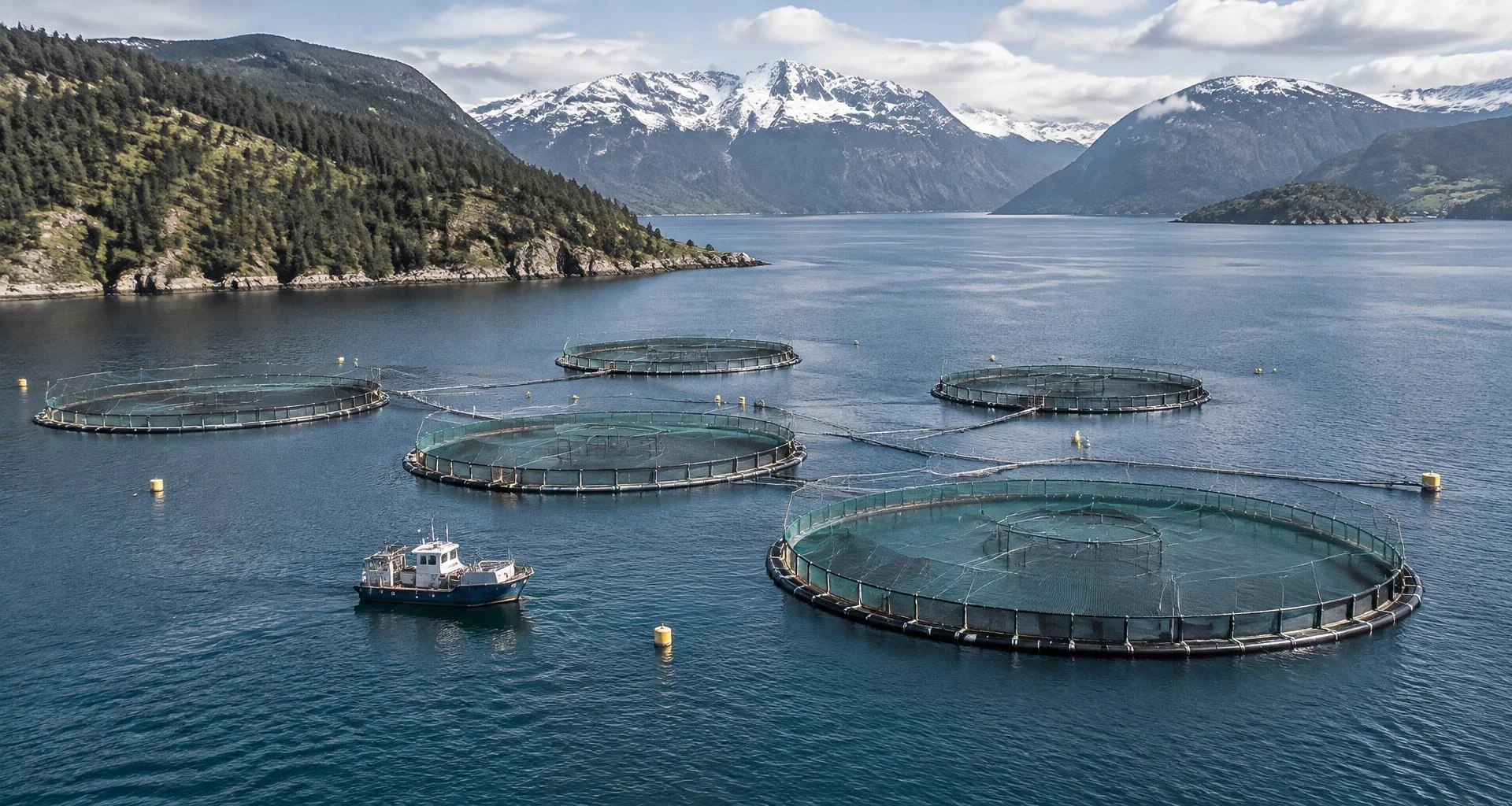
A salmon farm can measure oxygen, track feeding and monitor fish behaviour all day, yet struggle to answer a deceptively simple question: what actually influenced the fish's growth?
The problem may not be a shortage of data. Systems may disagree about fish groups, timestamps or definitions. And even a valid measurement is useless to a decision-making system if it never reaches it. As the seafood industry invests in automation and AI, three requirements become essential: Control, Context and Continuity.
The lesson from OptiVekst: integration is not the outcome
The FHF-funded OptiVekst project provides a useful reality check. Completed in 2026, it combined environmental measurements, feeding information, camera-based biomass and welfare observations, and production data at site, pen and fish-group level. The result was a shared data foundation demonstrating the potential of integrated analysis and machine learning for feeding decisions.
But the project also identified incomplete datasets, difficulties aligning observations across systems and limited feedback loops between feeding decisions and observed biological effects. It could not demonstrate measurable improvements in slaughter results. The trials were affected by sea-lice treatments, algae and jellyfish, complicating any attempt to isolate the effects.
This does not mean integration has no value. It means a working data platform and a measurable improvement in biological production are two different achievements. To understand why fish perform differently, producers need a reliable account of what happened, not simply another dashboard.
Control: who governs the information?
Aquaculture depends on specialist equipment and software from many suppliers. Cameras, feeding systems, sensors, fish-health applications and enterprise platforms may each hold a fragment of the production history.
Purchasing technology does not automatically settle who can access, interpret, export or reuse the data. Producers need clear agreements, usable interfaces, consistent identifiers and the ability to change suppliers without losing sight of their own production.
Companies don't need to develop every system themselves. But they do need control over how their own production data is accessed and used.
Could seafood learn from Animalia?
Norwegian livestock production offers an interesting comparison. What makes Animalia interesting isn't the technology itself. It's how the industry has organised and funded something they all benefit from. Owned by Nortura and the Meat and Poultry Industry Association (KLF), it develops shared professional services and data systems for the meat and egg sector. Its shared work is largely paid for by the industry itself.
The lesson is not to copy Animalia's ownership structure or funding mechanism. Seafood has different participants, commercial incentives and data-sharing concerns. The important question is whether shared definitions, standards and access rules can be governed and maintained beyond the lifespan of individual projects.
Seafood has already taken steps in that direction. AquaCloud has done important work on shared data standards. In March 2026, DNV announced an agreement to take over AquaCloud's technology, with plans to continue developing shared data standards for aquaculture. The FHF-funded HavbruksInfo project has also examined the requirements for a shared aquaculture data space.
These efforts raise an important question: who will govern, finance and maintain shared data foundations over time, while producers retain control of commercially sensitive information? That is a governance challenge. It is distinct from, but complementary to, the technical challenge of getting information reliably between systems.
Context: a measurement needs a meaning
Imagine comparing oxygen levels, feed consumption and growth between pens. Every underlying value might be accurate, yet the analysis can mislead if timestamps, fish-group identities, units or reporting cut-offs do not align.
Shared definitions allow systems to distinguish an original observation from a corrected record, a missing value from a genuine zero, and an estimate from a direct measurement. Production specialists must determine what those differences mean; technology teams must make the definitions consistent and accessible.
This becomes more consequential as AI moves from describing production to recommending or initiating actions. An agent may detect a pattern without knowing that some measurements are delayed. It should be able to recognise incomplete evidence, request fresher data or defer action instead of treating silence as certainty.
Continuity: being online does not mean being complete
- Seafood operationMeasurements captured
- GatewayAppropriate durable storage
- NetworkTemporary connectivity loss
- ApplicationsDelivery outstanding
Even correctly understood information can fail to reach the next system. A sensor reading may cross a gateway, an intermittent network, a cloud platform and several applications before it informs a decision. Each hand-off can fail differently.
Consider a coastal site where measurements continue to be captured during a network outage. The connection returns and new readings appear immediately. But were the older observations retained, delivered with their original timestamps and processed exactly as intended? Is a backlog still waiting? Could a retry create duplicate records?
A green dashboard cannot answer those questions alone. Reliable hand-offs require appropriate durable storage, controlled retries, stable event identities, duplicate handling and visibility into outstanding deliveries. Recovery is not complete simply because the connection is back.
These measures do not repair faulty sensors, recreate data never captured or replace local safety controls. They address a narrower but critical problem: information that was recorded but then disappeared, arrived late or was processed more than once.
At the fish landing, reliable records are becoming a formal requirement
The issue extends beyond fish farms. Norway has adopted new requirements for automated weighing systems at fish receiving facilities, scheduled to take effect for pelagic landings on 1 January 2027 and for other covered wild marine resources on 1 January 2028, subject to transitional rules and possible deferrals.
The requirements include local storage of weighing and relevant system-event data for at least five years, electronic transfer tied to landing identifiers, and procedures for correcting and resubmitting information. These are obligations for the applicable weighing and reporting systems; no single messaging product can be assumed to satisfy them on its own.
The practical question is straightforward: what happens to a mandatory weighing record when the network or receiving system is unavailable? Reliable data storage, traceability and electronic reporting are becoming formal requirements. Making sure the information still arrives when something goes wrong is the next practical challenge.
When the seafood is ready, but the information isn't
Near Oslo Airport Gardermoen, specialised seafood terminals handle refrigerated shipments, export documentation and time-critical cargo. Here, the link between digital and physical operations is easy to see.
A shipment can be packed, chilled and ready for departure, yet still be held up by missing information somewhere between the systems responsible for moving it.
The aircraft will not wait for the systems to catch up.
A delayed shipment can mean extra handling and cost. An unavailable ERP system would require different safeguards from a delayed message. Both illustrate the same operational truth: when information is a prerequisite for moving goods, a digital interruption can become a physical bottleneck.
Before giving AI more autonomy
In 2026, FHF called for stronger digital resilience across aquaculture, whitefish and pelagic operations. Cybersecurity, preparedness and the ability to restore critical processes all matter. So does the integrity of the information flowing between them.
Incomplete data may distort a conventional report. In an autonomous workflow, it may also trigger a decision: a revised production forecast, a feeding recommendation or an action downstream.
Before adding more intelligence, seafood companies should ask three questions: Do we control the data we depend on? Do we understand what it means? And can we verify whether the information needed for a decision has actually arrived?
Without signals about completeness, AI cannot reliably distinguish between nothing happening and nothing arriving.
And the more autonomy we give these systems, the more important that distinction becomes.
Sources
FHF | OptiVekst project results
Animalia | About Animalia: governance and financing
DNV | Agreement to acquire AquaCloud (2026)
Fiskeridirektoratet | New automated weighing requirements
Fiskeridirektoratet | Regulation J-28-2026