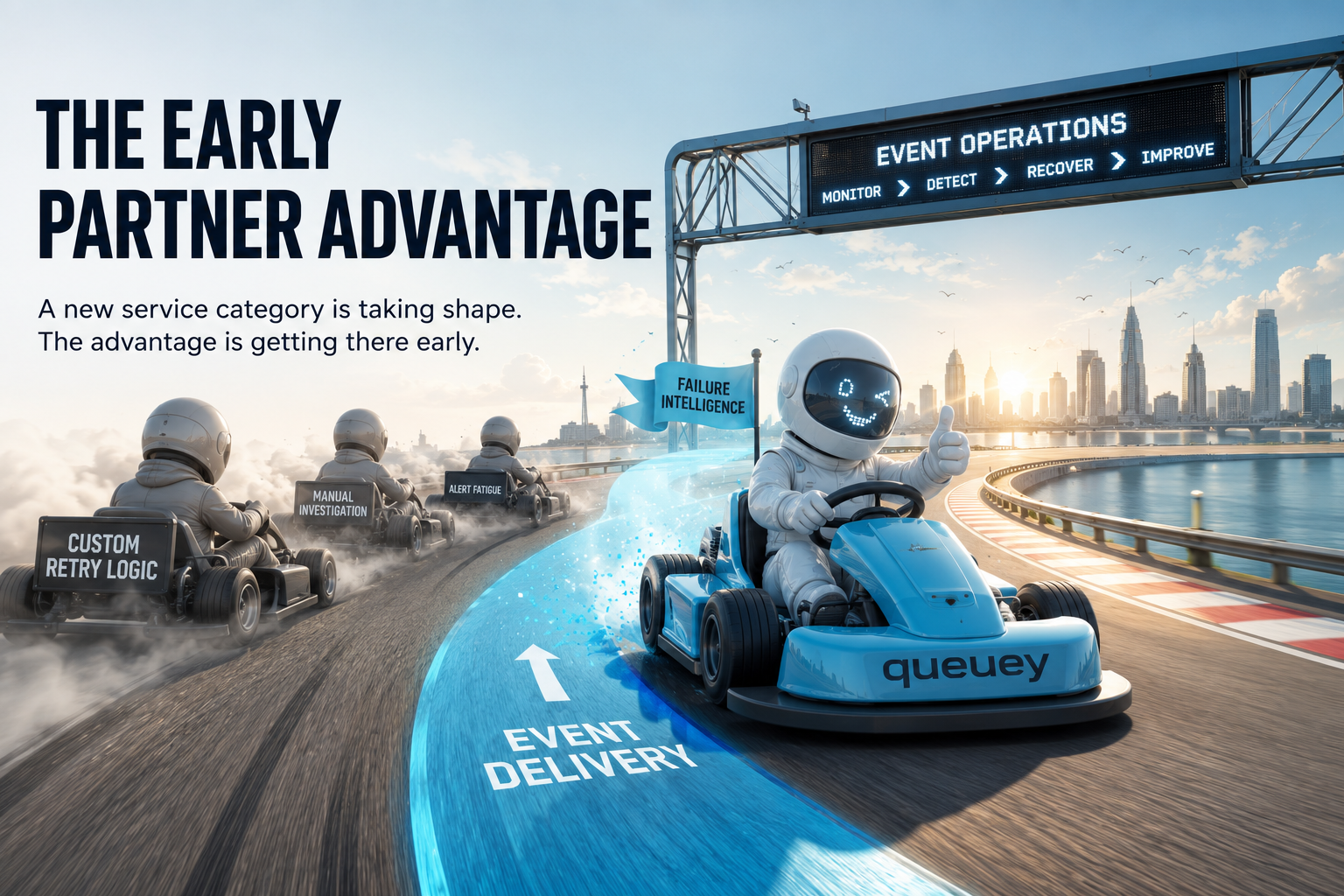
A new service category is taking shape. The advantage is getting there early.
This fall, we're looking for consulting firms that want to get there first.
Not first to resell another software product. First to build expertise and services around a problem that is becoming increasingly important as software becomes more event-driven:
What happens when events don't arrive as expected?
APIs fail. Webhooks break. Payloads change. Receivers go down. Rate limits are hit. Authentication expires. Sometimes a seemingly ordinary 500 is the first signal of a structural problem.
Today, much of this is handled inside individual applications through custom retry logic, monitoring and manual investigation.
Event Delivery is becoming infrastructure. Understanding failure is becoming the differentiator.
For consulting firms, that creates a new opportunity.
From delivery to intelligence
Getting an event from A to B is only part of the problem.
The harder problem starts when delivery fails.
Should a 503 be retried? Should a 429 wait? Is a 401 an authentication problem? Is a 422 telling you the payload has changed? Could repeated 500s reveal a structural mismatch?
Traditional event delivery focuses on whether an event arrived.
The next step is understanding why it didn't.
That's Failure Intelligence.
Patterns across events, payloads and responses can help identify what changed and determine what should happen next:
Retry. Wait. Stop. Alert. Investigate. Repair. Replay.
That turns reliable Event Delivery from infrastructure into an operational capability—and gives consulting firms something new to build services around.
Make it repeatable
Most organisations still solve these problems differently.
Failure handling lives inside applications. Retry strategies vary between teams. Monitoring is fragmented. Investigation depends on individual specialists.
Queuey provides a common Event Delivery foundation with Failure Intelligence built into it, allowing partners to turn bespoke engineering into a repeatable capability.
| Traditional approach | Repeatable approach |
|---|---|
| Failure logic lives inside applications | Common Event Delivery foundation |
| Retry first, investigate later | Detect and classify failures |
| Teams investigate incidents manually | Evidence helps identify what changed |
| Every project creates its own monitoring | Shared operational patterns |
| Expertise stays with specialists | Knowledge becomes reusable methodology |
| Engagement ends at go-live | Operations become a managed service |
The impact goes beyond technology: faster delivery, faster onboarding, lower delivery risk, better margins and expertise that scales without specialist headcount growing at the same rate.
Build Event Operations services
This is where we see the real partner opportunity.
Queuey isn't another product to put in a partner catalogue. It gives partners an Event Delivery and Failure Intelligence foundation around which they can build their own Event Operations services.
- An Event Reliability Assessment can analyse how critical business events are delivered and what happens when they fail.
- An API & Webhook Reliability Review can uncover weak retry strategies, silent failures and fragile recovery processes.
- An AI Workflow Readiness Assessment can determine whether the APIs, webhooks and events underneath autonomous workflows are operationally ready for production.
- And Managed Event Operations can turn monitoring, failure detection, recovery and optimisation into an ongoing service.
Assess → Implement → Monitor → Detect → Recover → Improve
Every engagement improves the methodology. Every failure creates knowledge. Every customer makes the capability stronger.
Repeatability compounds.
Why this fall matters
The problems already exist.
What hasn't been established is who will own them.
Reliable Event Delivery is becoming increasingly important as more business processes depend on APIs, webhooks and autonomous workflows. But the consulting practice around it barely exists.
That's what makes the timing interesting.
Will every company continue building its own failure handling and recovery logic? Or will Event Delivery become a distinct operational capability—with methodologies, tooling and managed services around it?
That shift has already started.
The infrastructure is arriving before the consulting category around it. That's the window.
As AI agents and autonomous workflows take more actions across APIs, knowing that something failed will no longer be enough.
Organisations will need to understand what failed, why it failed and what should happen next.
By the time customers start asking for that capability by name, early movers will already have the expertise, methodology and customer references.
A head start, not software access
This fall, we want to work closely with a small number of consulting firms that see this opportunity early.
Software access isn't the advantage. A head start is.
The opportunity is to build the first packaged Event Operations services, develop methodologies and establish expertise while the market is still taking shape.
Queuey brings the Event Delivery infrastructure and Failure Intelligence.
Partners bring the customers, industry expertise and delivery capability.
And the firms that come in early get something that becomes impossible to buy later:
Time.
Time to learn. Time to build IP. Time to establish references. Time to become associated with the capability before the market becomes crowded.
This fall isn't about becoming another Queuey partner.
It's about building the practice before everyone else does.