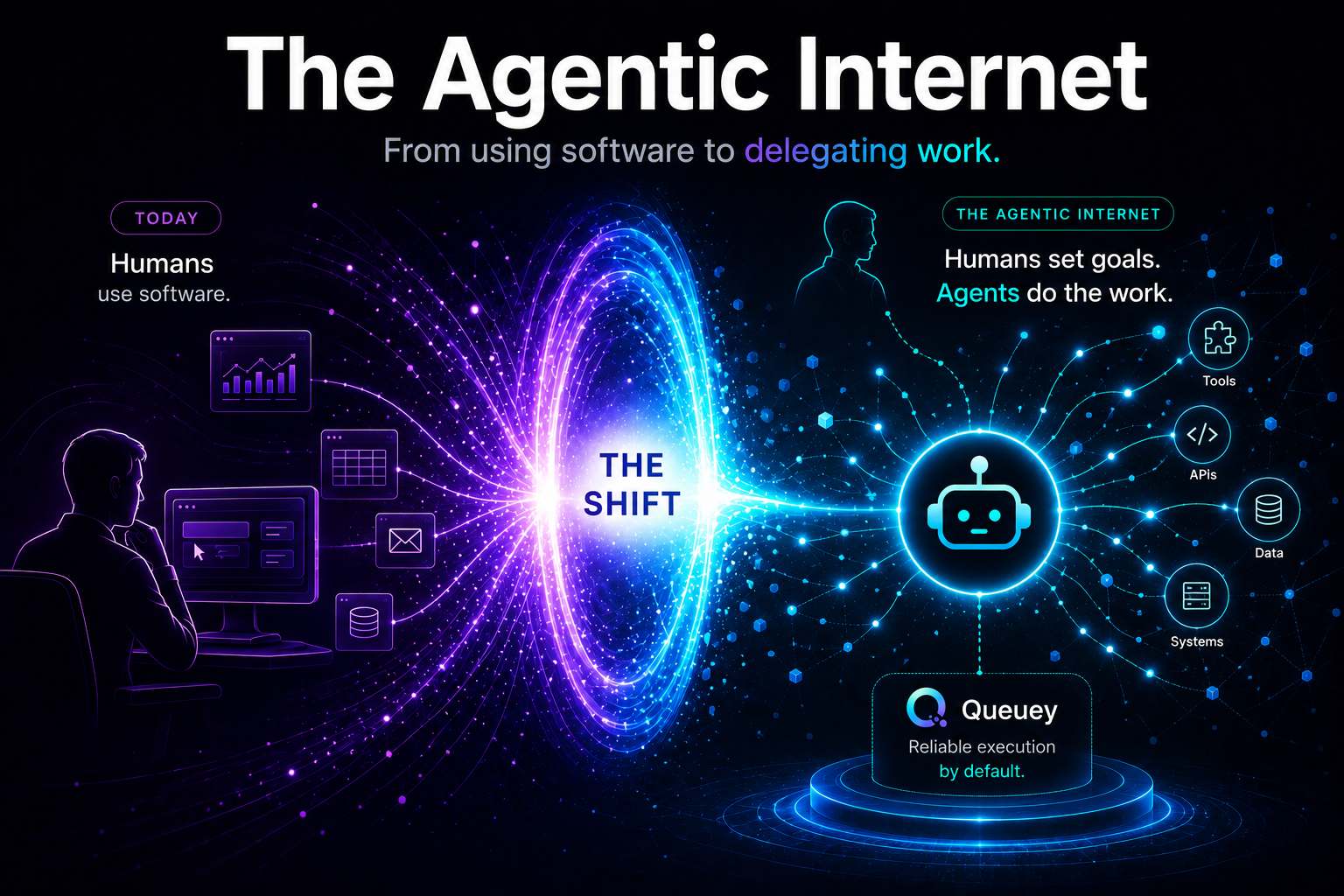
One of the more interesting misconceptions about the Agentic Internet is that it's somehow the successor to Web3.
I don't think that's true.
I understand why the comparison is made. Both are presented as the next chapter of the internet. Both promise new ways of connecting systems. Both challenge assumptions about how today's platforms work.
But I think they're solving fundamentally different problems.
Web3 emerged as a response to centralization. The idea was simple: users should own more of their digital lives, whether that's identity, assets, data, or online relationships. The debate was largely about control and ownership.
The Agentic Internet is about something else entirely.
It's about execution.
For the first time, we're building systems where software doesn't just provide information—it performs work. AI agents can discover tools, interact with applications, coordinate workflows, and make decisions within defined boundaries. Instead of humans navigating software, software increasingly acts on behalf of humans.
That's a very different shift.
Web3 required wallets, blockchains, and smart contracts. The Agentic Internet requires orchestration, governance, observability, and reliable communication between agents, tools, and enterprise systems.
More importantly, the incentives are different.
Companies pay for work to get done. They don't buy software because it's philosophically interesting. They buy it because it saves time, reduces cost, or creates new opportunities.
Ownership matters. But execution creates value.
The more organizations we talk to, the more obvious another pattern becomes. Many companies—and especially leadership teams—believe they are much further along in their AI journey than they actually are.
They've experimented with ChatGPT, rolled out Copilot, or launched a handful of AI initiatives. But moving from AI-assisted work to systems where agents can reliably take action across business processes is an entirely different challenge.
The gap between using AI and operationalizing AI is much larger than most organizations realize.
That's where the real work begins.
Most enterprise software today is designed for humans. The next generation will be designed for agents first, humans second.
An agent doesn't care whether a service is centralized or decentralized. It cares whether it can find the right tool, complete a task, recover from failure, and deliver an outcome.
Standards like MCP are emerging to make that possible, creating a common way for agents to discover and use tools across systems. But protocols alone won't be enough. Agentic systems also need an operational layer that can manage events, workflows, retries, policies, and interactions at scale.
That's where companies like Queuey fit into the picture. As more agents move from demos into production environments, the infrastructure that connects agents, tools, and enterprise systems becomes increasingly important.
Web3 tried to change who owns the internet.
The Agentic Internet is changing who works on it.
Web3 asked:
"Who owns the internet?"
The Agentic Internet asks:
"Who does the work?"
And for the first time in history, the answer may not be human.