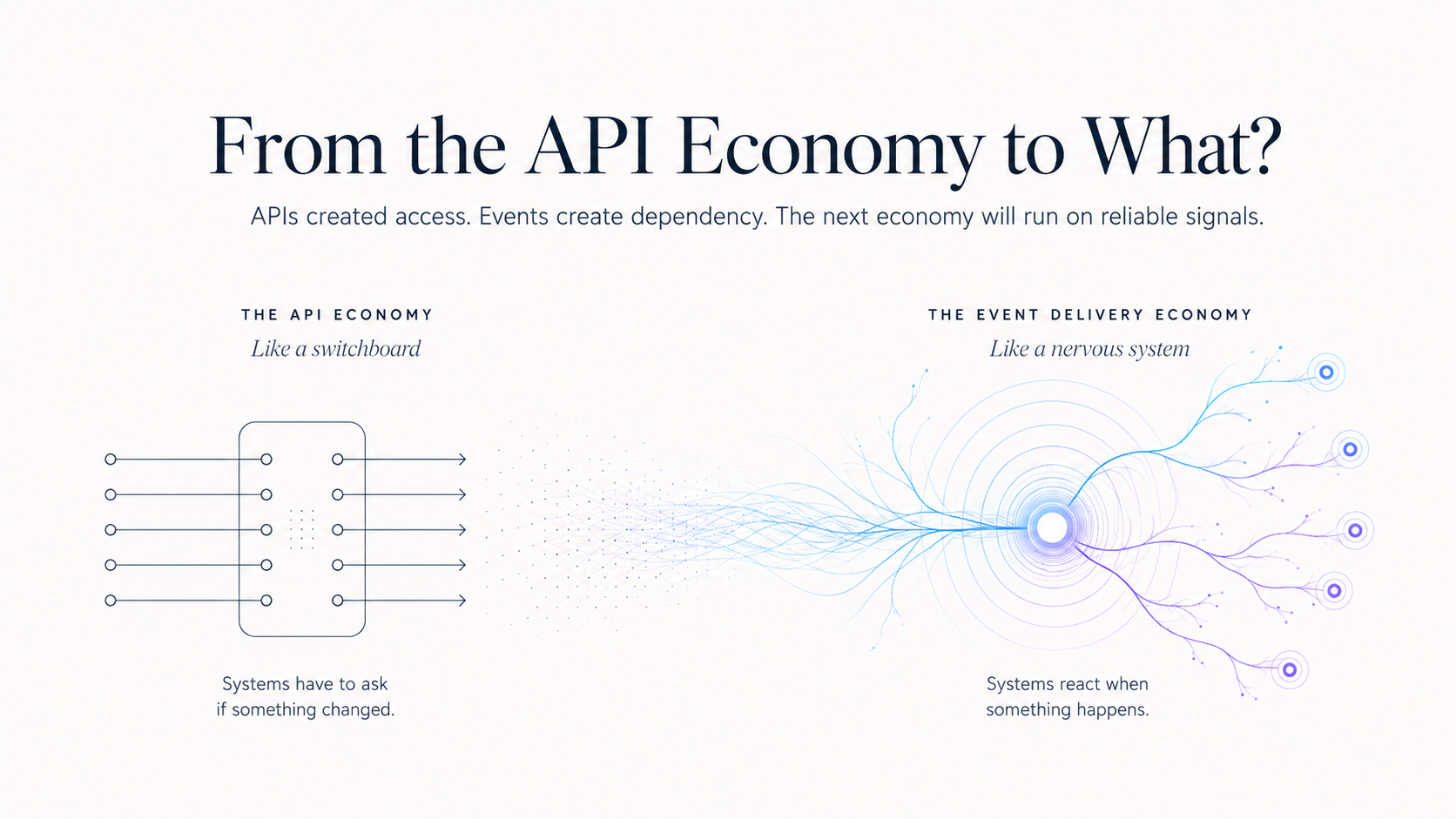
For the last decade, every platform wanted to become an API platform.
Expose the data. Publish the docs. Let partners build.
That was the API economy.
So what comes next?
The API economy is becoming the event delivery economy
Not because APIs disappear. They will not.
But because the most important integrations will no longer be built around systems constantly asking if something changed. They will be built around systems reacting to what just happened.
- An invoice was created.
- A customer changed.
- A payment failed.
- A document was approved.
APIs let systems ask.
Events tell systems what happened.
That changes the platform question
Not:
"Do you have an API?"
But:
"Do you offer two-way webhooks? Or is your system doomed to be polled forever?"
Webhooks are easy — until they aren't
A webhook is easy when the receiver answers 200 OK.
The real test starts when the receiver is down, slow, misconfigured or returning 500.
- Do you retry blindly?
- Can support explain what happened?
- Can the partner replay safely?
- Or does engineering become the human retry button?
The hidden cost of partner integrations
Every new endpoint increases the surface area where your product can look broken, even when your own system is healthy.
The partner endpoint fails. Your customer complains.
The next phase makes this sharper
AI agents and autonomous workflows will react to events, not refresh dashboards. A missing event will not just be a missed notification. It may become a missed action.
That is why the layer after the API economy is reliable event delivery: two-way webhooks, replay, circuit-breaking, dead-letter handling, signing, evidence and visibility.
The real product isn't webhooks
We call Queuey a Webhooks as a Service layer.
But the real product is not webhooks.
It is operational trust between systems.
Because the next economy will not run on access alone.
It will run on signals that can be trusted.